

Why Train with Only One Gun?
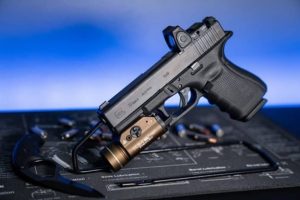
In training sessions, many think they should get as much practice as possible with as many types of concealed carry weapons as they have at their disposal. There’s some logic to this. Eager new gun carriers are anxious to get the full experience. They want to learn as much as they can, as fast as possible.
However, it is not recommended by those who teach courses on the proper handling of concealed carry handguns.
Gun enthusiasts are no different from musicians, golfers, artists, or computer geeks. They all want to experience all the high tech toys that come with their craft.
It should come as no surprise that shooters have a fascination with concealed carry gear. As shooters become more focused on honing their craft, they become less interested in the toys and more interested in perfecting skills. The handgun then becomes a tool. Advanced marksmen will tell you to stick with one handgun for practice. This allows you to hone your skills in drawing, aiming, shooting, reloading, cleaning, and caring for your firearm.
When you know your gun intimately and automatically, you are far less likely to freeze in the face of a deadly encounter. If you switch from one gun to another, you may miss a step or hesitate a second or two. These seconds may well mean life and death.
Maximizing your familiarity with your concealed carry weapon is critical.
There are other reasons to stick with a single gun:
- Familiarity with Your Handgun’s Trigger
When skillful marksmanship is critical your ability to manipulate the trigger is a measure of good shooting. It takes thousands of repetitions to gain true familiarity with the trigger on a specific handgun. All triggers are not equal. For example: a Glock trigger is very different from that of an M&P trigger. Both are unlike 1911 trigger. Trigger systems can be shot at a high level of excellence. However each demands a different dynamics. You have to be dedicate to master the trigger of your concealed carry firearm.
If you move from one trigger mechanism to another, there’s a very different feeling and reaction. These deeply affect your shooting performance. Using different guns complicates your ability to shoot seamlessly.
If you want variety, try using multiple guns of the same model. At the very least with related models that have similar triggers. If you are using a full-size M&P, try a compact M&P, or even an M&P shield. Most shooters soon discover that there are subtle differences even between guns of the same model. The moral is: The more time you spend with your one gun, the better your skills will become.
- Grip
You may be surprised to learn that grip is as important as trigger in refining your shooting skills. That’s why it’s important to use one handgun. Grips feel different from model to model and even from handgun to handgun with the same grip type.
Familiarity with the grip of your weapon will improve your shooting in several ways. Your hand will become accustomed to gripping that handgun. This feel doesn’t transfer to another gun. Each is as unique as a person’s handshake or fingerprint.
Grip affects speed of draw. The angle, shape, and size of the grip all make a difference when it comes to making a fast draw from your holster. Getting used to a certain grip you build up speed. If you switch to a different size pistol and/or one with a different grip, then your speed of drawing will be thrown off. Even the changing to an unfamiliar angle will negatively influence your draw. Just like with the trigger, the more draw repetitions you have with a single gun and the same grip, the better your speed will be.
Grip also influences how you control the trigger of your pistol. Everyone’s hand is slightly different. So too, is the way your hand interacts with your weapon. Going from one gun to another doesn’t give you a chance to tweak your skill with grip and trigger.
If you usually shoot using a relatively wide grip and you change to one with a thinner grip, the relationship of your finger with the trigger changes. Your shooting accuracy will be affected. You may shoot too far left or right, high or low.
Spending time with a single gun helps you modify your technique to that weapon. When you change guns, you lose that familiarity and also that advantage.
Minimize the number of handguns you train with and carry. I know you will be tempted to collect and try out a variety of firearms. Temper your enthusiasm. You will be a better shooter for having done so.


